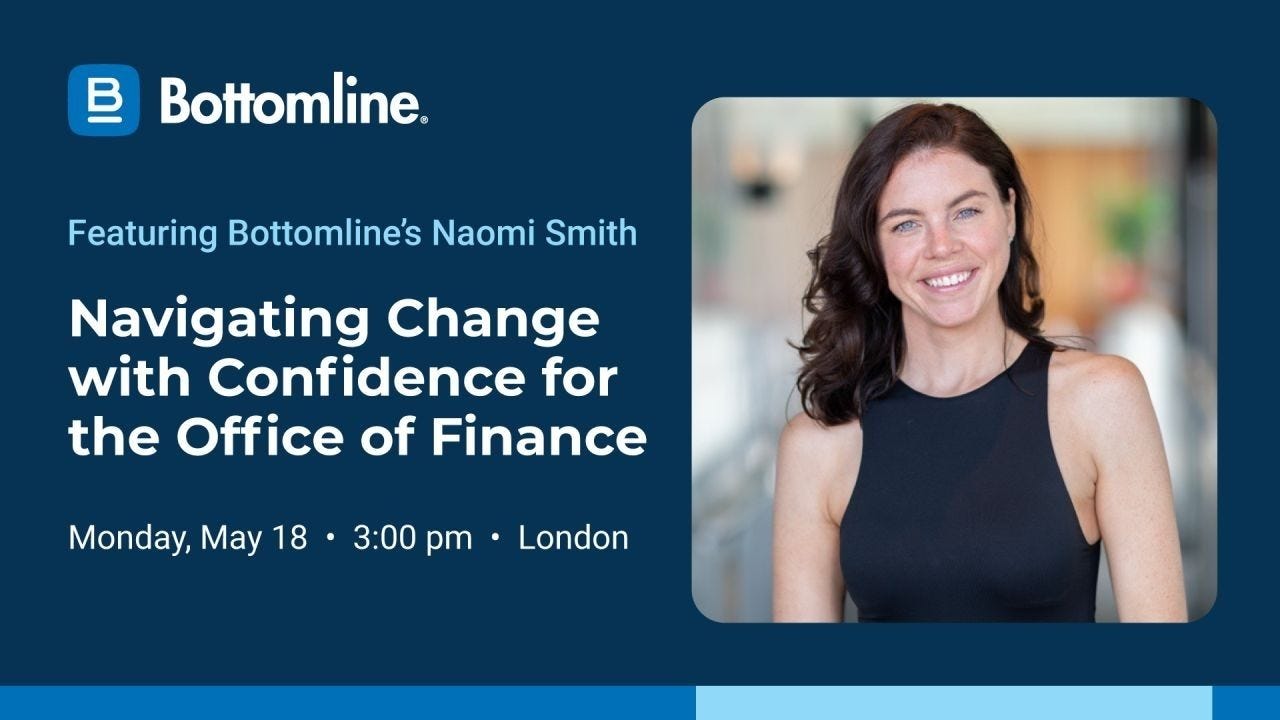
A guest Blog by: Naomi Smith, Senior Solutions Consultant at Bottomline
On May 18th 2026, more than 40 senior finance leaders came together in London for Navigating Change with Confidence, a leadership forum designed to explore what the future of the Office of Finance truly looks like in practice. The event was organised by Women in Collaboration, a collective of female groups spanning the entire fintech space across the UK.
Set against a backdrop of funding pressure, regulatory complexity, fragmented systems, and accelerating AI adoption, the conversations throughout the afternoon made one thing clear: finance is no longer being asked to simply keep pace with change, but rather to lead it.
At the event, I had the pleasure of joining Panel 3, Trailblazing Innovations for the Finance Office in This Era of AI. It was a standout session; not just for the breadth of perspectives on stage, but for the honesty and depth of the discussion. As with many of the most valuable moments across the event, the real insight came from the interplay between practitioners, from finance leaders to technologists and researchers, all grappling with the same transformation from different angles.
One of the most impactful parts of the day was hearing directly from two CFOs – Bina Khatwani, who is a fractional CFO across multiple businesses, and Regina Lau, CFO at Weavr.io. Their perspectives brought a level of clarity that is difficult to replicate in strategy decks or market positioning. There was strong alignment with how many organisations, including us at Bottomline, are thinking about the evolution of the CFO role and the opportunity around AI-enabled finance. At the same time, they offered important nuance around how change is actually unfolding inside organisations, particularly under real-world constraints.
What emerged from those conversations was a clear narrative that the CFO role is undergoing a fundamental shift. No longer confined to retrospective reporting or financial control, today’s CFO increasingly sees themselves as a central architect of business strategy, often second only to the CEO in shaping direction and outcomes. The focus is moving decisively toward forward-looking forecasting, strategic alignment, and enabling better, faster decision-making across the enterprise.
AI is playing a critical role in enabling this shift, but notably, the tone from finance leaders was grounded rather than hyped. There is genuine excitement about the potential of AI, particularly in its ability to unlock insight and improve forecasting. However, there is also a strong recognition that real transformation is required to realise that value.
As one theme captured succinctly during the discussion: “Financial institutions and corporates are asking what we do ‘about’ AI. However, the real question is what we do ‘with’ AI.”
This distinction reframes the conversation entirely, from adoption to application and impact.
Perhaps the most important point of alignment was that AI is not being approached as a cost-cutting exercise. Instead, it is seen as a way to elevate the finance function, freeing teams from manual data gathering and enabling them to focus on higher-value, insight-driven work. In other words, the ambition is not to reduce the role of finance, but to expand its impact.
That ambition, however, rests on a critical foundation: data.
Throughout the event, data remained a consistent anchor in the conversation. The need for centralised, trusted, and accessible data is not new, but it is becoming more urgent as organisations look to scale AI adoption. Without it, confidence in both insights and decisions quickly erodes. Alongside this, regulatory requirements and the complexity of operating across multiple jurisdictions continue to add layers of challenge, making governance and data integrity more important than ever.
In my part of the discussion, I reflected on how the AI conversation in finance has evolved over the past seven years. What began as early experimentation with machine learning and predictive analytics has now moved into a much more advanced phase, first with generative AI, and increasingly toward agentic models capable of taking action as well as generating insight.
As these capabilities develop, the question is no longer just what AI can do, but how organisations can adopt it responsibly. One framework that resonated during the discussion was the idea of approaching agentic AI through three critical lenses:
Governance – ensuring accountability, transparency, and regulatory alignment
Gateways – controlling how AI systems interact with enterprise data and infrastructure
Guardrails – defining clear boundaries for safe and effective operation
This structure reinforces a broader point that, in finance, trust is everything. And as AI moves closer to decision-making, that trust becomes the defining factor in how far and how fast organisations can go.
Closely linked to this is the emerging concept of agentic capital — the value created when organisations can trust AI systems not just to inform decisions, but to augment and execute them at scale. It also raises an important shift in how success is measured.
Finance leaders are beginning to move beyond traditional metrics like cost savings and efficiency. Instead, there is a growing focus on outcomes such as:
Decision quality
Speed to insight
Tangible business impact
This signals a broader evolution from efficiency-led transformation to value-led transformation. It brings AI much closer to the core strategic mandate of the CFO.
The session was further enriched by an academic perspective from Dr Zeynip Hizir, with insights on where AI is heading next and how organisations should prepare. This blend of real-world execution and forward-looking thinking added an important dimension, reinforcing that while the technology is advancing rapidly, thoughtful adoption remains key.
And yet, beyond all the discussion of systems, data, and AI, one of the most defining aspects of the event was the community itself. Being surrounded by so many talented and supportive women leaders in finance and technology, such as Catherine Turner, Leslie Stephenson, Ninika Nanda, Ellie Duncan, Sally Duckworth, and Muskan Varshney, created a unique energy, one grounded not just in ambition but in collaboration.
It served as a powerful reminder that the future of the Office of Finance is not being built in isolation. It is being shaped collectively, through shared experience, open dialogue, and a willingness to challenge and learn from one another.
As the role of finance continues to expand, the mandate is becoming clearer. The Office of Finance must be integrated, intelligent, insight-driven, and influential.
The challenge now is not whether finance will transform, but how confidently it can lead that transformation.